The Great Embroideries of Bukhara Textile & Art Publications, 2000 | ||
________________________________________________ CONTENTS Part 1: Suzani and Their Makers ________________________________________________ | ||
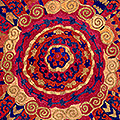
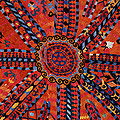
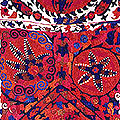
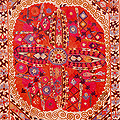
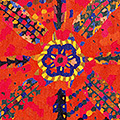
The Large Medallion suzani are named after their dominant feature: a large central medallion. This can be round, oval, square or hexagonal, and in several cases it is so immense that it fills the entire central field. In some instances the latter is surrounded by a primary border flanked by narrow guard borders, which are either partially or fully embroidered. Several other examples have simply a fully-embroidered single guard border, making the central medallion so dominant that it enhances the monumentality of the overall design. | ||
| Also included within the group here are five examples that do not have the medallion, but have all the minor ornaments and technical features to suggest that they were made by the same embroiderers. The designs of the Large Medallion group clearly illustrate that, while the motifs used on suzani undoubtedly evolved from a traditional art form, the rules of the tradition - as to exact shape and placement of ornaments, for instance - do not appear to have been strict. Thus the different examples, whilst superficially looking remarkably similar, upon closer inspection are very much individual works of art. | ||
| A lengthy article by Gisela Helmecke, published in 1997, discusses in great depth the possible interpretation of the elements of the Large Medallion design. While pointing out that it would be wrong to consider that every rosette has mythical symbolism, she suggests possible interpretations for many of the minor elements: the birds being symbols of the soul or auspicious emblems; the jugs symbolising water and thus life. Much of this sounds logical, and undoubtedly is pertinent to the work of many Central Asian tribes, adding a worthy insight into the study and appreciation of these beautiful objects. For although the majority of the population were devout Muslims, their traditions had developed from far more ancient origins. | ||
| However, whatever other symbolic significance it may have had, the most obvious interpretation of the central motif on Large Medallion suzani is that it is a giant version of the many other elements that surround it: a flower. It is impossible to say exactly which flowers these medallions might represent because they are so stylized - perhaps a poppy is most likely - but the component parts, the stamen, leaves and buds, remain discernible. Quite possibly each flower had a particular meaning. Perhaps the symbolism of the flowers and the heavenly bodies were intertwined. | ||
| Unfortunately, there is no surviving contemporaneous literature to substantiate any interpretation of the symbols, and it is also undoubtedly true that the form and meaning of motifs used in a traditional society evolve over time, even simply through constant repetition. What a symbol represented to the peoples that embroidered it must surely have been different to its original conception, possibly centuries earlier. In this study, therefore, a cautious approach has been followed, focusing instead on analysing and comparing the patterns on the corpus of surviving examples. It is by looking closely at the detail that the overall picture gradually becomes clearer. | ||
| Fifty-one of the fifty-four Large Medallion suzani now known can be divided into ten sub-groups or types, formed on the basis of certain shared features (the other three are so far the only known examples with their particular design). These groupings are not intended to imply that the examples within each are specific to a workshop, district or region, but rather to facilitate the comprehension and appreciation of the repertoire of compositions and individual ornaments, and to promote discussion. No doubt, in time, other types will come to light to expand this even further. | ||
| Return to: Items for Sale - Central Asia | The Textile Gallery | Textile & Art Publications | ||
The Textile Gallery All text and images ©
textile-art, 2000: not to be reproduced without permission | ||